Species & Breeds
Parakeet Color Mutations: A Complete Visual Guide (Blue, Lutino, Albino & More)

Reviewed by Dr. Marian Hollis, DVM (ABVP-Certified Avian Practitioner) · Last reviewed May 2026
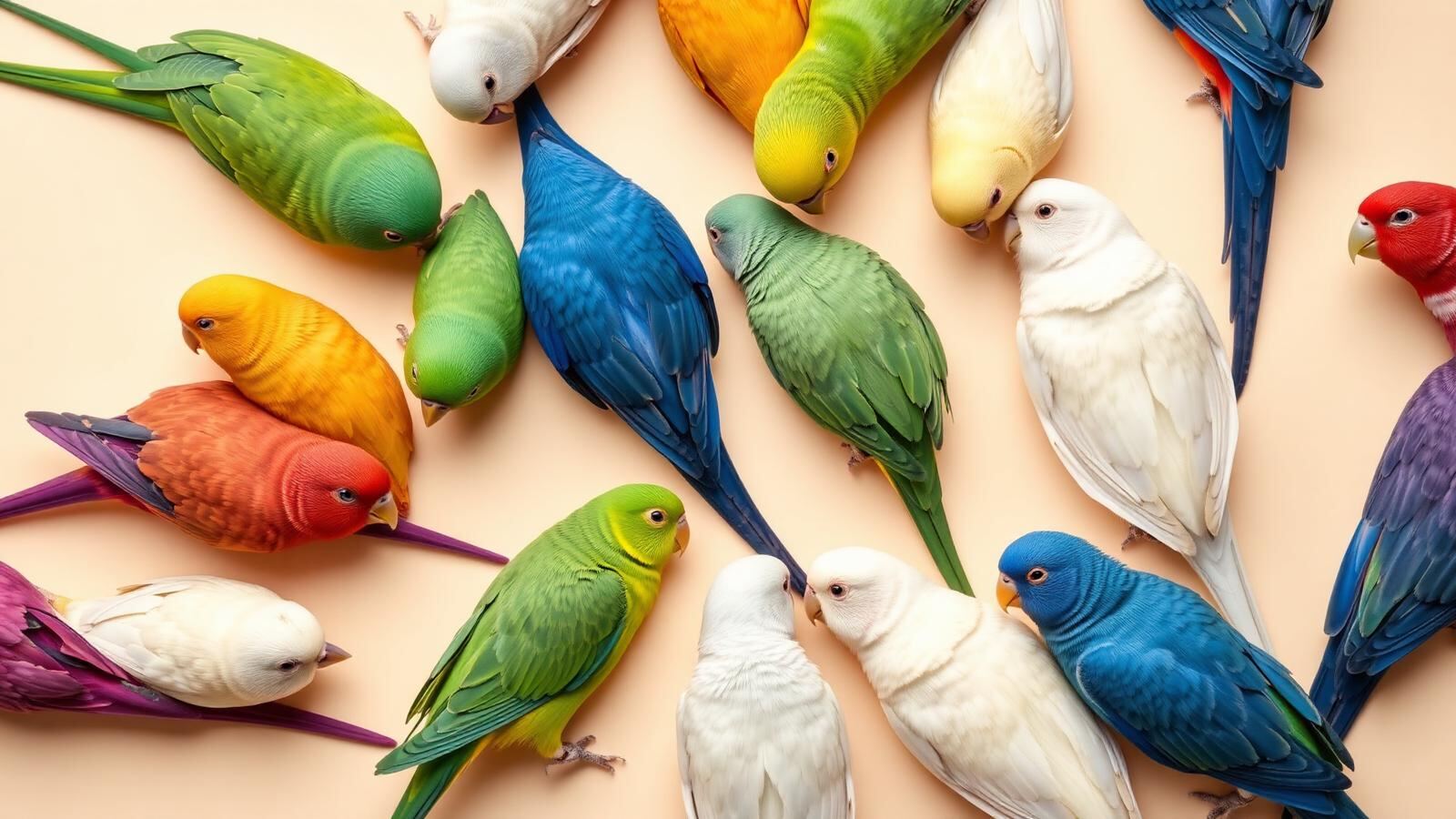
Wild parakeets are green. Every other color you've ever seen — from sky blue to butter yellow to ghost-white — is the result of a recessive or sex-linked gene that humans have been selecting for since the 1870s.
There are now more than 30 recognized budgie color mutations, plus countless combinations. This guide walks through the ones you'll actually see in pet stores, breeder ads, and rescues — what they look like, what causes them, and which combinations carry health risks.
How budgie color works
Two pigments build every parakeet you'll ever meet: psittacin (yellow) and melanin (the dark stripes). Structural blue comes from feather microstructure, not pigment. Mutations either remove a pigment, dilute it, or change where it appears.
The 4 base series
- Green series — wild-type, dominant. Yellow + structural blue + black markings.
- Blue series — recessive. Yellow pigment removed; the bird looks blue/white.
- Yellow-faced — incomplete dominant. Blue body, yellow only on the face.
- Grey/grey-green — dominant grey factor over green or blue base.
Common mutations you'll see
Lutino (sex-linked)
Pure butter-yellow with red eyes and pink feet. All melanin removed; psittacin remains. Females express it more easily; in males, both X chromosomes must carry the gene.
Albino (sex-linked + blue series)
Pure white with red eyes. Lutino on a blue base = no psittacin and no melanin. Stunning but light-sensitive — never house in direct sun.
Spangle (dominant)
Reverse markings: each wing feather is light with a dark edge instead of dark with a light edge. Single-factor spangles look bright; double-factor spangles look almost solid white or yellow.
Opaline (sex-linked)
Reduces black markings on the head and back, leaving a clear 'V' between the wings. Often combined with cinnamon or violet for show birds.
Cinnamon (sex-linked)
Black markings replaced with warm brown. Eyes plum-red as chicks, darken with age. Pairs beautifully with opaline.
Recessive pied
Random patches of clear color on the body, often a 'bib' under the chin. The bird's cere stays dark even in adult males — a common sexing mistake.
Dominant pied (Australian pied)
Symmetrical band of clear color across the chest, with a clean cap. Cere develops normally so sexing is reliable.
Violet (dominant factor)
Deepens any blue-series budgie into a saturated purple. A cobalt budgie + violet factor = the classic 'visual violet.'
Greywing, clearwing, dilute
Three alleles at the same locus that reduce black markings to grey, near-white, or fully diluted body color. Clearwings look painted — solid body, white wings.
Combination mutations
| Common name | Recipe |
|---|---|
| Rainbow | Opaline + yellow-faced + clearwing on blue base |
| Lacewing | Lutino + cinnamon (sex-linked combo) |
| Crested | Crest gene over any color |
| Anthracite | Recessive black factor on grey-blue base |
| Texas clearbody | Sex-linked clearbody, body color cleaner than wings |
Mutations to be careful with
- Double-factor spangle × spangle pairings can produce non-viable chicks. Never breed spangle × spangle.
- Crested × crested can produce embryonic lethal. Always pair crested to a plain bird.
- Lutino and albino birds have weaker pigment in the eye — keep out of direct sunlight and provide UV-safe full-spectrum lighting.
- Anthracite and dark factor birds can be slightly less heat-tolerant.
Does color affect personality?
Not directly. But heavily inbred show lines (especially double-factor spangles and exhibition lutinos) often act calmer simply because they're less athletic. The myth that 'blue budgies are sweeter' has no genetic basis — it's selection bias from quieter pet-store stock.
Frequently Asked Questions
What's the rarest budgie color?
Anthracite (true black) and clear-flight pieds with full clear flights are the rarest in the pet trade. Show-quality double-factor spangles also command high prices.
Are albino budgies blind?
No. They have full vision but reduced pigment in the iris, making them more sensitive to bright light.
Can I tell mutation from a baby budgie?
Mostly yes. Some markings (cinnamon vs normal) are easier to see at fledge. Final adult color settles after the first molt around 4 months.
Do mutations affect lifespan?
Most don't. Heavily linebred show mutations can shorten lifespan due to inbreeding depression — buy from breeders who outcross every 2–3 generations.
Sources & Further Reading
- Association of Avian Veterinarians — aav.org
- VCA Animal Hospitals — Bird Care Library
- Lafeber Vet — Companion Bird Nutrition
Medically reviewed
Dr. Marian Hollis, DVM — ABVP-Certified Avian Practitioner
Cascade Avian & Exotic Veterinary, Portland OR
Last reviewed May 2026 · About the author
Your turn
What did your parakeet teach you the hard way? Share your story by emailing hello@perchandplume.com — the best replies appear in our weekly letter.