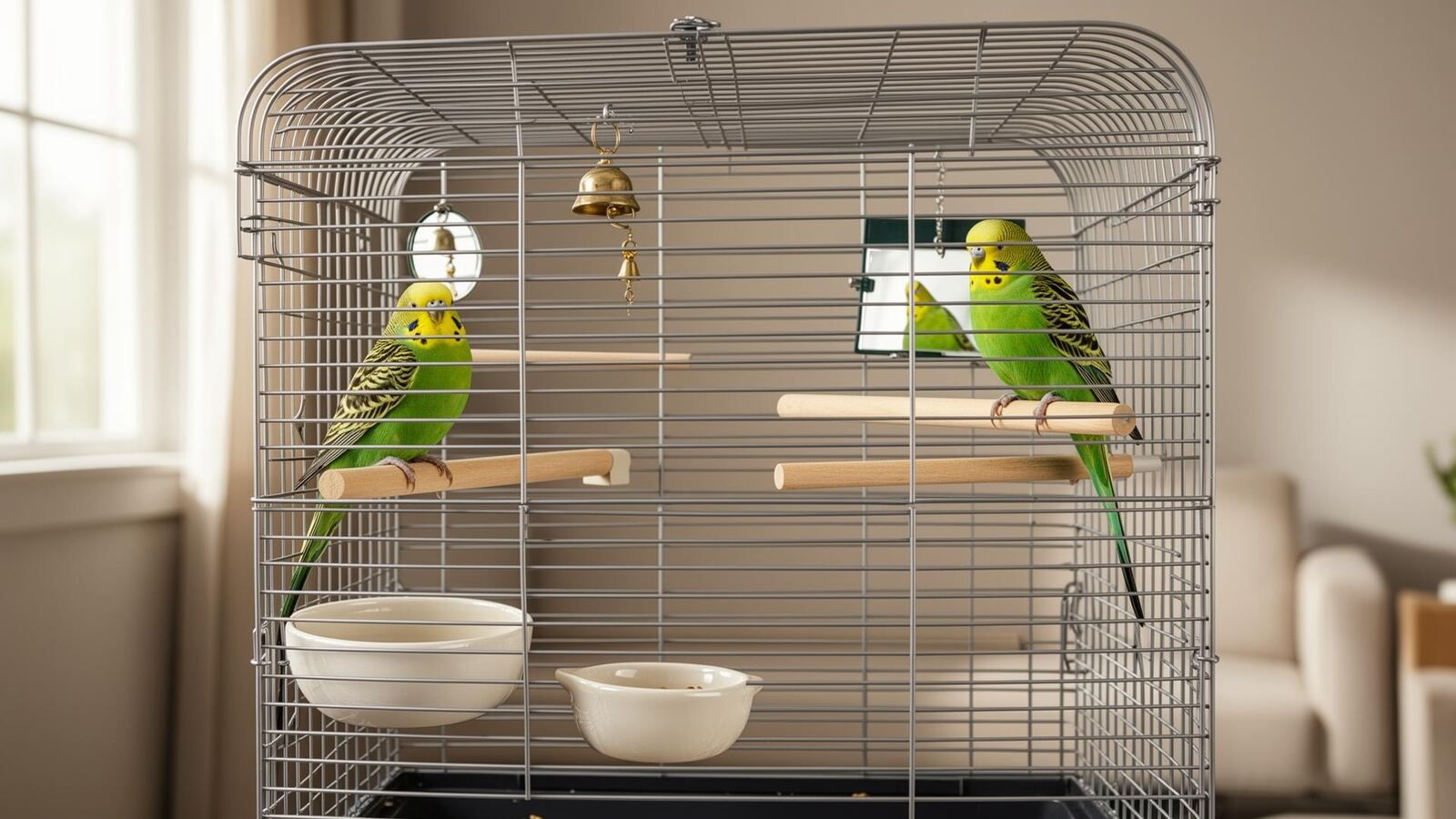
Cage Setup & Toys
Parakeet Cage Setup: The Complete 5-Zone Blueprint for a Happier Bird

Reviewed by Dr. Marian Hollis, DVM (ABVP-Certified Avian Practitioner) · Last reviewed May 2026
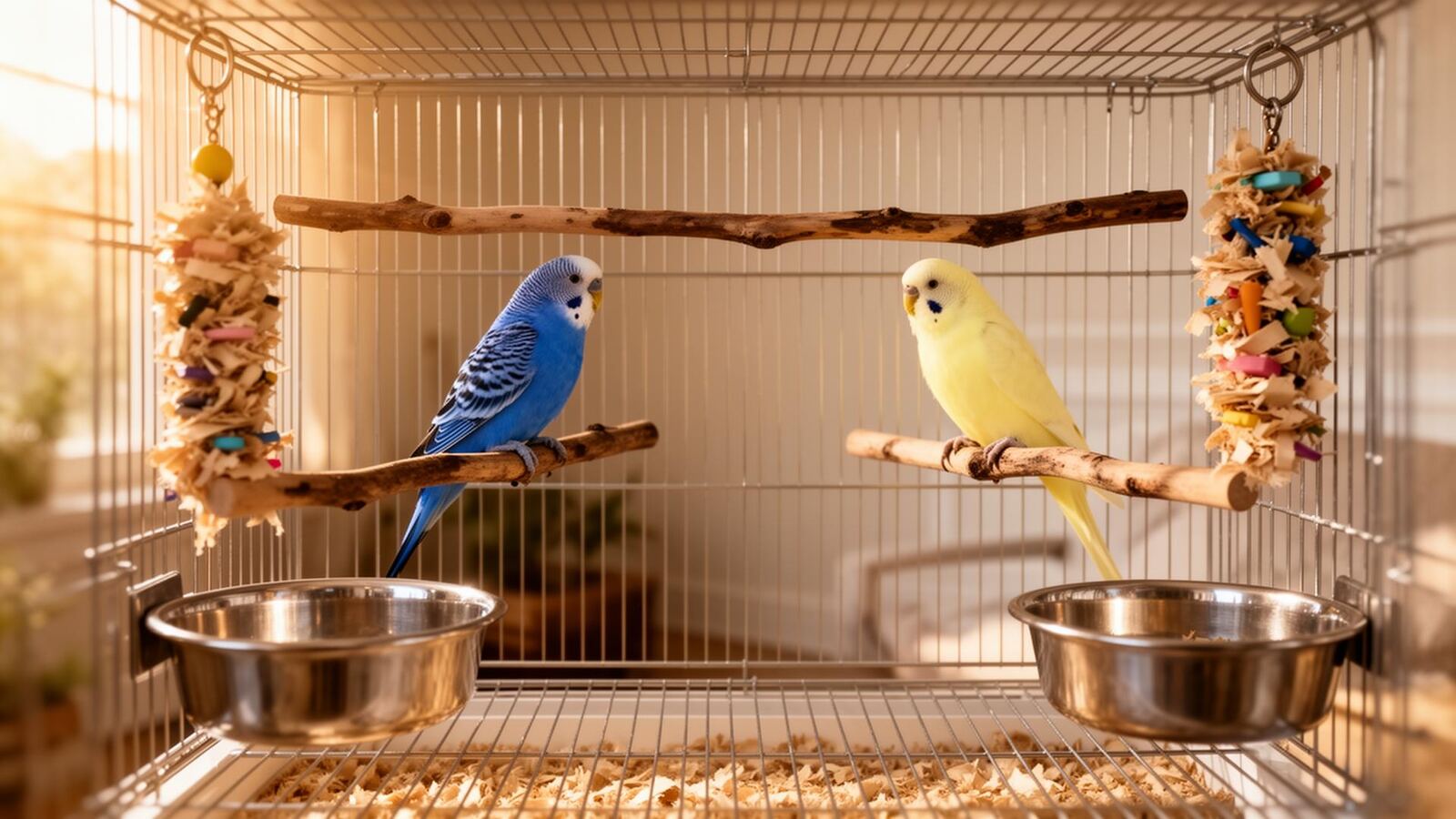
A good cage is not a decorated box—it is your parakeet’s bedroom, dining room, gym and safe retreat. This room-by-room blueprint shows exactly where every perch, bowl and toy belongs while preserving the open flight space many setups accidentally lose.
The 10-minute cage audit: start here
Stand six feet from the cage and look through it. Can you see an open horizontal lane from one side to the other? Can your bird reach food without crossing a curtain of toys? Is there a high, quiet sleeping perch? If not, the problem is usually zoning. A useful setup gives every activity a place and leaves the center deliberately empty.
| Check | Target | Why it matters |
|---|---|---|
| Cage shape | Wide rectangle | Budgies fly horizontally |
| Bar spacing | 1/2 inch or narrower | Reduces entrapment and escape risks |
| Flight lane | Open end to end | Encourages short flights |
| Perches | 3–5 varied branches | Changes foot pressure |
| Toy load | 2–4 active toys | Enrichment without crowding |
| Floor | Plain paper liner | Makes droppings easy to monitor |
Step 1: choose dimensions that support real movement
Width is the most valuable measurement. For two budgies, roughly 30 × 18 × 18 inches is a practical baseline rather than an ideal finish line; buy larger when possible. A tall narrow cage can contain more cubic inches yet prevent horizontal flight. Measure usable interior space after bowls and doors.
- Prefer bird-safe finished metal from a reputable maker.
- Avoid rust, flaking paint, sharp welds and decorative gaps.
- Choose a large front door for calm handling and cleaning.
- Confirm every access door closes securely.
- Clean grates frequently if used.
The 5-zone blueprint
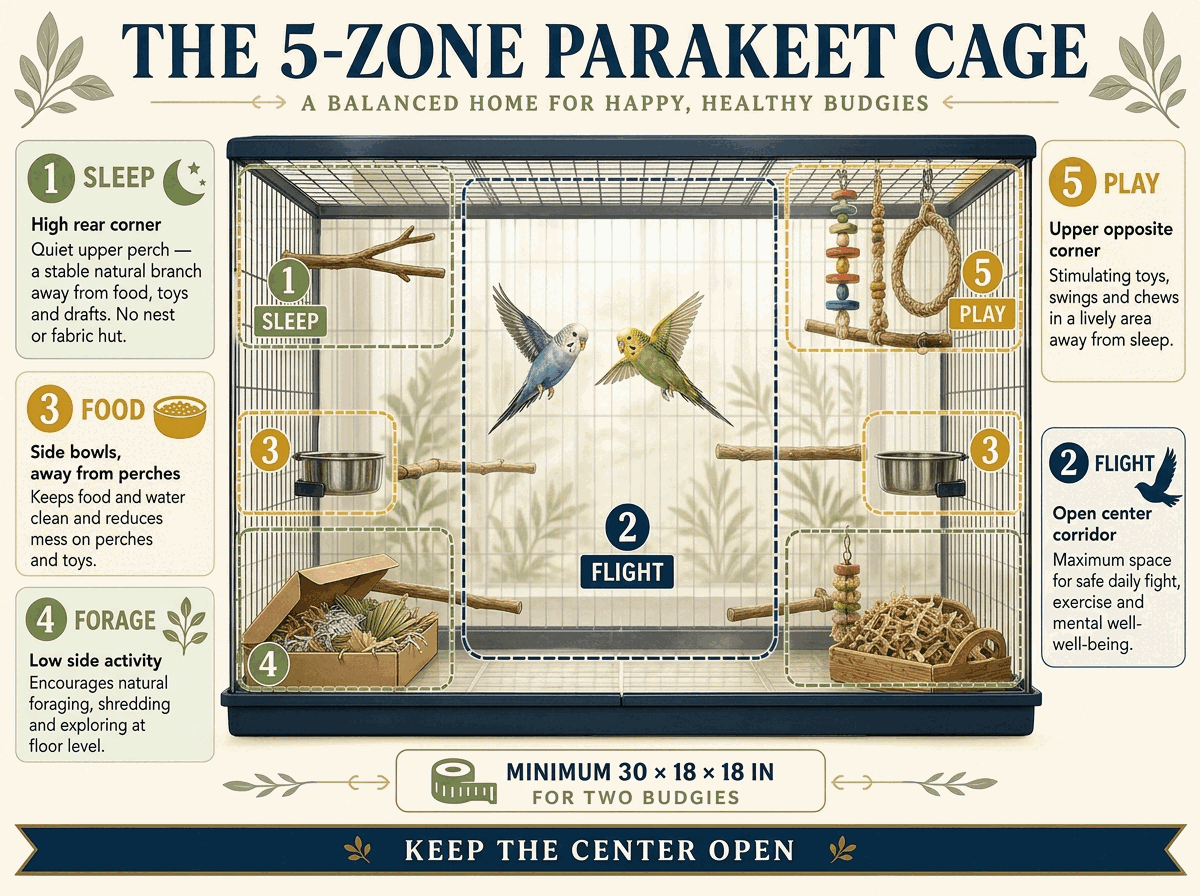
Zone 1 — Sleep: quiet and high
Place one secure natural perch in an upper rear corner, away from the busiest toy and above no bowl. Companion budgies do not need a nest, tent or fuzzy hut; enclosed spaces can encourage breeding and loose fibers can catch toes.
Zone 2 — Flight: the empty center
Install the two main perches near opposite ends so a bird can hop, flap or fly between them. Keep toys and ladders out of this corridor. Empty space is exercise equipment.
Zone 3 — Food and water
Mount stainless-steel or glazed ceramic bowls on a side wall with no perch above. Separate fresh and dry foods, remove moist produce after a few hours, and wash water dishes daily.
Zone 4 — Forage
Use a clean tray or paper cup with crinkle paper and familiar food. Start with food visible, then gradually hide it. Never forage in soiled substrate.
Zone 5 — Play
Group a chewable toy, a shreddable toy and perhaps a swing in the upper corner opposite sleep. Rotate rather than continually add.
Build a foot-friendly perch system
Uniform dowels hold every toe in one position. Use scrubbed pesticide-free natural branches in several diameters, often around 3/8 to 3/4 inch. Toes should wrap securely without meeting completely underneath.
| Perch type | Use | Watch for |
|---|---|---|
| Natural branch | Primary standing and sleep | Unknown wood or splinters |
| Platform | Brief pressure change | Soiling |
| Rope | Only tightly woven and intact | Remove when fibers loosen |
| Smooth dowel | Temporary route | Not as the only surface |
| Sandpaper cover | Avoid | Can abrade feet |
Choose the safest room position
Put one or two cage sides near a solid wall with family life visible. Avoid kitchens, smoke, aerosols, scented candles, fireplaces, direct air-conditioning, open doors and prolonged harsh sun. Overheated nonstick coatings can release fumes rapidly fatal to birds.
The best location is socially connected but physically protected.
Setup-day sequence
- Wash, rinse and dry the empty cage.
- Install sleep and main travel perches first.
- Attach bowls where droppings cannot fall.
- Add only two familiar quiet toys initially.
- Line the tray with plain white paper.
- Photograph the setup for comparison.
- Introduce future items one at a time.
A cleaning rhythm that works
| Frequency | Task |
|---|---|
| Every morning | Fresh water, remove wet food, inspect floor |
| Every evening | Wipe debris and check closures |
| 2–3 times weekly | Replace liner and wash used perches |
| Weekly | Wash tray, rotate toys, inspect attachments |
| Monthly | Deep-clean and check rust or paint |
Seven common setup mistakes
- Buying height instead of width.
- Filling the center with toys.
- Using only smooth dowels.
- Putting bowls below perches.
- Using mirrors as social substitutes.
- Adding huts for ordinary sleep.
- Changing the entire layout at once.
How to know it works
Watch behavior for two weeks. A successful layout invites movement between ends, relaxed sleep, daily interest in destructible toys and easy bowl access. Persistent pacing, avoidance, night panic or immobility deserve a setup review and avian veterinary advice.
Your one-hour cage reset
- Inspect the empty cage shell.
- Keep three to five safe perches.
- Protect the central flight line.
- Create separate activity zones.
- Return only two or three varied toys.
- Add clean paper and fresh bowls.
- Photograph and observe before adding more.
Frequently Asked Questions
What is the minimum cage size for two parakeets?
A practical starting point is about 30 × 18 × 18 inches, but bigger is strongly preferred. Horizontal flight length matters more than decorative height.
How far apart should parakeet cage bars be?
Bar spacing should generally be no wider than 1/2 inch for budgies to reduce head-entrapment and escape risks.
Where should food and water bowls go?
Attach bowls to a side wall with no perch directly above. Keep water away from the floor and replace it at least daily.
How many perches should a budgie cage have?
Most cages need three to five thoughtfully placed perches in varied safe diameters, with a clear horizontal route between the main perches.
Should I cover my parakeet cage at night?
A breathable cover can help provide 10–12 hours of darkness, but maintain ventilation and leave part uncovered if your bird has night frights.
Do parakeets need a nest or sleeping hut?
No. Healthy companion budgies sleep standing on a stable perch. Nest boxes and fabric huts can trigger hormones and introduce chewing hazards.
Sources & Further Reading
- Association of Avian Veterinarians — aav.org
- VCA Animal Hospitals — Bird Care Library
- Lafeber Vet — Companion Bird Nutrition

Medically reviewed
Dr. Marian Hollis, DVM — ABVP-Certified Avian Practitioner
Cascade Avian & Exotic Veterinary, Portland OR
Last reviewed May 2026 · About the author
Your turn
What did your parakeet teach you the hard way? Share your story by emailing hello@perchandplume.com — the best replies appear in our weekly letter.